
Back in mid-December, I wrote about the potential unwind of the yen carry trade and its spillover into U.S. Treasuries. Fast forward to today, Japan’s political backdrop has shifted meaningfully.
In late January, Prime Minister Sanae Takaichi dissolved parliament and called a snap election on February 8. The result? A landslide victory for the ruling coalition and one of the strongest mandates in decades. That effectively clears the runway for expansionary fiscal policy including tax cuts and additional stimulus.
Markets responded quickly. The Nikkei opened at record highs, and 10y JGB yield moved back toward decades high range as investors priced in heavier bond issuance and fiscal expansion.
Looking ahead
Given the evolving political and financial backdrop in Japan, I maintain the bearish view on JGB and that could lead to
- More capital repatriation
- Further carry trade unwind
- Japan moving back onto global allocation radar
The key variable to watch as discussed in mid – December : the relationship between UST–JGB yield basis and hedging costs. YTD the yield basis has narrowed by 35 bps, while hedging costs have declined by about 30 bps. That math matters. If hedging costs decouple from the bond yield basis movement, a larger-scale capital repatriation would likely follow, adding upward pressure to the UST curve. I maintain the view of bearish steepening bias on UST.
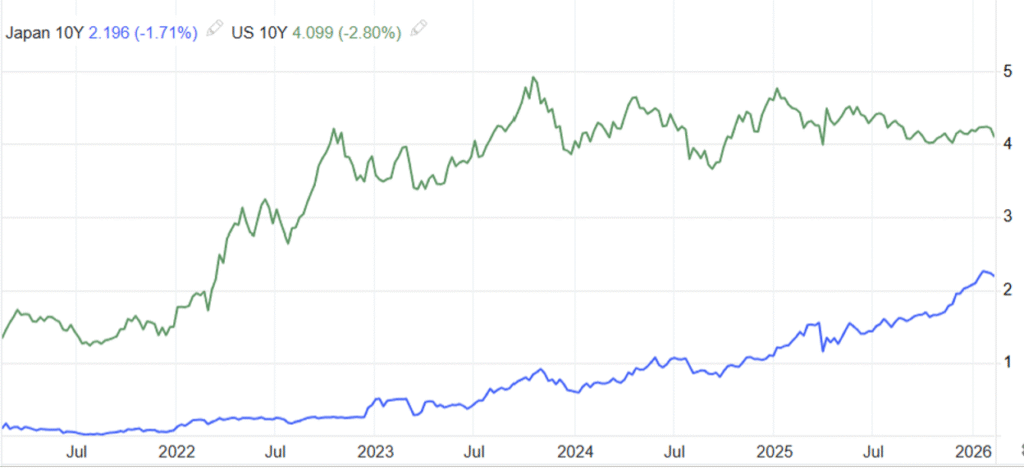
Source: Trading Economics