

Japan is back in the spotlight, not only because its new prime minister is inheriting some elements of the Abe era, but also due to proposed fiscal policies that are significantly affecting its financial markets, particularly JGBs. The 10Y JGB yield has jumped from 0.5% last summer to touch 2%, drawing market attention and raising questions about a potential carry trade unwind.
What is Carry Trade?
A carry trade involves borrowing money in a currency with low interest rates and investing it in a currency with higher rates. The JPY carry trade has been popular for more than two decades, dating back to Japan’s ultra-low rates regime in the mid-1990s. This dynamic has partly contributed to Japan becoming the largest foreign holder of U.S. Treasuries with $1.2 trillion in holdings.
Japanese life insurers, in particular, hold significant foreign asset exposure, with a strong allocation to USTs. When investing in USTs, life insurers usually weigh both bond yields and hedging costs. If hedging remains cost-effective, even a rise in local bond yields doesn’t materially shift allocations away from USTs. This was evident in the September data: while overall foreign demand for USTs softened, Japan remained the top foreign buyer.
However, when interest rate differentials are no longer sufficient to offset FX hedging costs, the carry trade stops working, and foreign-currency assets become less attractive, increasing the risk of position unwinds.
Hedging Mechanics
Life insurers hedge FX exposure mainly via currency swaps. Hedging costs are broadly equivalent to the interest rate differential (i-i* ≈ F-S). Hedging is rarely done on a 1:1 duration or notional basis; instead, insurers favor partial hedges with shorter tenors for flexibility and market liquidity.
In 2024, 10Y UST-JGB bond basis was 350 bp, with the 3Y implied hedging cost at 357 bp, resulting in a net lock-in yield of –7 bp. Today, the bond basis has narrowed to 220 bp, while 3Y implied hedging cost has declined to 240 bp, compressing the net lock-in yield to –20 bp and reducing the attractiveness of fully hedged UST positions.
Looking Ahead
Heading into 2026, the spread between hedging costs relative to the UST–JGB yield basis will be the key variable to watch. Investors with limited access to the currency swap market may have already initiated carry trade unwinds. For larger movements, particularly from life insurers, this could occur if interest rate differentials diverge significantly from the yield spread. A widening basis could trigger substantial capital repatriation to Japan, further adding pressure to U.S. Treasuries.
Maintain a bearish-steepening bias on the curve.
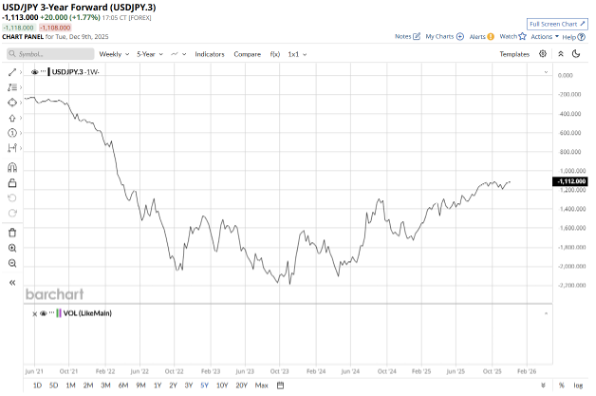
Source: Barchart