

Last Mile: Solidifying a Strategy
- Last mile warehouses are critical pieces of urban infrastructure and have become the backbone of e-commerce permeance.
- These smaller warehouses tend to be under 50k sq ft, and are bucking the overall industrial trends when it comes to vacancy, leasing, and PSF statistics.
- Focusing on small-bay and urban facilities can provide a durable thesis for retail investors looking to capitalize off e-commerce and mobile order growth, especially in consumer staples.
Over the last decade, last-mile logistics assets have moved from a niche industrial category to a core component of urban commercial real estate. A shift in consumer expectations has created an environment of instant gratification, which has carried over to the e-commerce space. It is commonplace to see same-day or even two-hour delivery windows, and as a result cities have been forced to confront a structural truth: retail is no longer on Main Street. It now lives inside the supply chain, and oftentimes our phones from where we complete these orders.
This change in preference, which the Covid-19 pandemic heightened, should have been expected. RTO, demands at home, and other obligations have eroded at what little time consumers can dedicate to frequent grocery store runs to stock their homes. While the need for consumer staples has grown, frequency of visits has gone down. “Covid-19 and Retail Grocery Management: Insights from a Broad-Based Consumer Survey” reports a roughly 20% reduction in grocery-store browsing duration during the pandemic, while showing an increase in spend per trip.
The data implies that while spending per trip and overall consumption remain healthy, the time bricks-and-mortar retail commands is declining. For investors and developers interested in retail-adjacent, anchored, or shadow-anchored real estate, this suggests an emerging bifurcation: increasing demand for consumption, but diminishing need for large-format, high-traffic shopping footprints. Instead, logistics, micro-fulfillment centers, and supply-chain real estate may offer a more durable real estate thesis under changing consumer behavior.
A Tale of Two Vacancies:
The numbers regarding urban warehouse leasing and vacancies tell an interesting story. Big box warehouses experienced a spec construction boom in the early 2020s that outpaced demand and leasing abilities.
Vacancies in overbuilt cities and their outlying areas persist. A few major moves and build-to-suit projects have helped absorb space, but many industrial markets remain overbuilt. Vacancies in general have climbed for 11 quarters, and reached 6.9% by Q1 2025. This is a stark contrast to vacancies that hovered around 4% during Covid between 2020 and 2022.
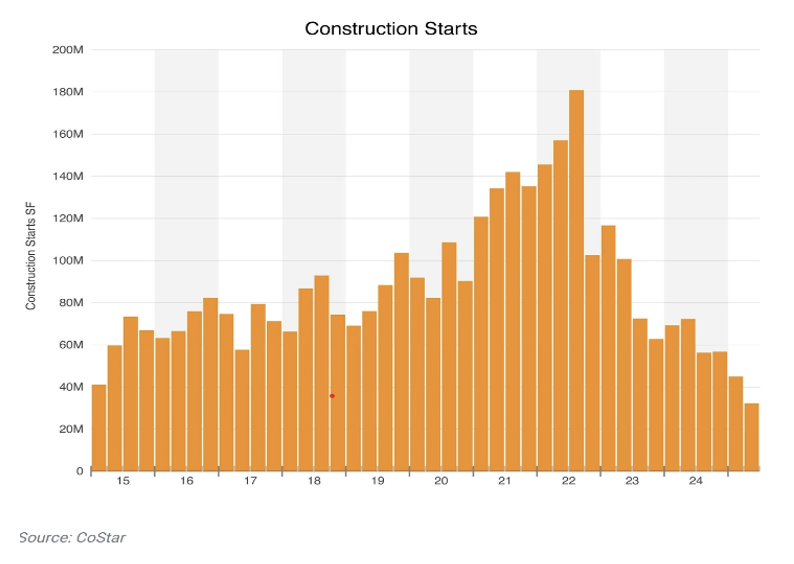
Roughly 322 million SF of industrial space was delivered nationally in the past year, compared with only 125 million SF of net absorption, meaning new construction has far outpaced tenant demand. At the same time, rent growth has cooled sharply. After pandemic-era double-digit annual increases, average asking rents in early 2025 were essentially flat quarter-over-quarter, with year-over-year growth slowing to 2.1%. This marks the weakest growth since 2012 and a steep decline from nearly 10% in 2022 and about 7% in 2023 that the industrial market commanded. Sales volumes tell a similar story. In 2021, over $21B of trades were executed in the industrial and warehouse space, which plummeted to about $10B by 2024. Cap rates decompressed during this period too, going from mid-4s to between 6 and 7% for core warehouse assets.
This differs from smaller, infill facilities under 50k sq ft, where vacancy hit 3.8% this year. Rents, while still heavily market-dependent, are also up on average 2.5% YoY and sit at around $12.99 a foot. Coastal gateway cities and densely populated urban infill locations continue to drive growth and demand in the small-bay and last mile subsectors. This growth is due to macro factors like high barriers to entry, population density, and micro factors in rapidly growing metros such as Charlotte and Orlando where service and construction industries fuel local economies. Time on the market also starkly differs across asset size. As of 2025, <50k sq ft spaces typically lease up in about 4 months vs. 17 months for >100,000 sq ft spaces.
Conclusion:
Last-mile warehouses are not a legacy holdover from pandemic-era e-commerce growth. They are rapidly becoming a structural pillar of 21st-century commercial real estate which offers developers, investors and capital markets professionals a rare combination of durable demand, flexibility and continued growth potential. Adding a flex component only fortifies their durability to withstand various cycles and buck leasing trends. Given shifting consumer behavior, ongoing retail evolution, and supply-chain re-orientation, last-mile warehouses are well-positioned to emerge as one of the most sought-after CRE property types over the next several years. As we launch “What’s the Deal,” I look forward to diving deeper into sectors like this and helping translate emerging CRE trends into actionable capital-markets strategies.
Please follow along as “What’s the Deal?” begins exploring trends in drone deliveries, data centers, and other critical parts of CRE and tech that are shaping how we live, spend, and interact with each other. Also to come? “City Spotlight”, which will feature high-octane analyses in major CRE cities across the U.S., and why we need to be paying attention to them.