

- Miami has evolved from a flashy, momentum-driven market into one that rewards disciplined underwriting, capital markets and structuring expertise, and certainty of execution.
- Capital remains active across asset classes, but deployment is increasingly selective, relationship-driven, and highly sponsor-focused.
- In today’s environment, successful transactions in Miami-Dade are defined less by headline pricing and brand names, and more by how capital is sourced, structured, and aligned.
Miami has entered a more mature phase of its growth cycle, which is defined less by momentum or branded beachfront condo buildings, and more by underwriting discipline that yields executional certainty. While the local market continues to benefit from long-term demographic and economic tailwinds, the conditions that once supported rapid price discovery and abundant liquidity have given way to a more selective, fundamentals-driven environment, which is replicating other gateway cities within the United States.
This shift reflects a recalibration as capital markets adjust to rate turbulence, elevated construction costs, and a more hands-on approach to risk. For owners and developers, success in today’s Miami market depends on precision: understanding where demand is durable, how capital is being deployed, and how transactions are structured to navigate near-term volatility while preserving long-term value. From huge events like CREFC to curated meetings with local players, GSP is tracking appetite across the capital markets to provide the best coverage for sponsors looking to deploy in Miami.
Work, Play, and Real Estate Demand Fundamentals
Despite increased selectivity across capital markets, Miami’s underlying demand drivers remain intact. Continued population inflows, employment growth across professional services and technology, and the city’s evolution into a live-work-play destination continue to support long-term housing and mixed-use demand. Tourism and hospitality fundamentals remain resilient, while multifamily performance has begun to differentiate more clearly by location, asset quality, and pricing strategy.
What is changing is how demand is being underwritten, especially across multifamily. Rent growth compressed in 2025 as new supply was delivered, particularly in key submarkets, prompting a more granular view of absorption, concessions, and operating costs. Assets with strong locations, thoughtful unit mix, and realistic pricing assumptions outperformed in 2025, reinforcing the importance of local market knowledge and disciplined underwriting as Miami transitions into its next phase of growth.
Demand vs. Volatility: What Rent Growth Projections Say
While portions of the Sunbelt have experienced short-term rent pressure with elevated supply coming online, forward-looking projections continue to differentiate Miami from many peer markets. According to forecasts, Miami is among a limited group of major U.S. markets projected to achieve more than 3% rent growth in 2026, despite experiencing modest rent compression in the most recent period.
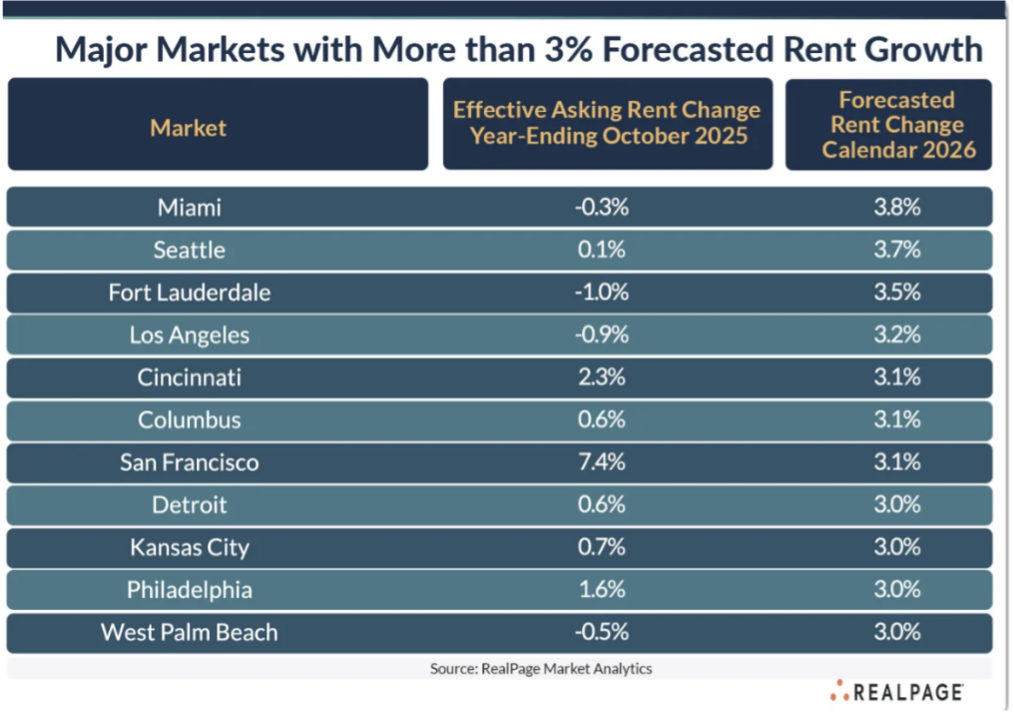
This divergence between near-term performance and medium-term expectations reflects potential market recalibration. In Miami’s case, new supply absorption, sustained population inflows, and long-term demand drivers continue to support positive rent growth assumptions once current inventory is absorbed. Also interesting to note is Fort Lauderdale and West Palm Beach, neighboring cities in southern Florida. These three cities were the only ones which experienced rent compression, and are all projected to rebound similarly.
For capital providers, this dynamic reinforces the importance of basis discipline and hold-period alignment. Transactions are underwritten with conservative near-term assumptions, paired with confidence in Miami’s longer-term growth trajectory. This is particularly true for well-located, well-capitalized assets.
Capital Markets in Miami: A Narrower Path to Execution
Miami transactions are getting done, but the margin for error has narrowed. Lenders are underwriting conservatively, with leverage and proceeds driven as much by asset-level execution as by broader market conditions. In practice, this has shifted the emphasis away from maximizing terms and toward structuring deals that can clear credit committees without prolonged iteration.
Stabilized assets continue to attract bank capital, though assumptions around expenses and reserves are being scrutinized closely. For assets in transition, debt funds have become an increasingly common solution to bridge lease-up, repositioning, or near-term volatility. Regardless, the ability to align business plans with how lenders are currently underwriting risk assumptions across asset class has become a key factor in whether transactions close.
Submarket-level performance, real-time absorption trends, and lender sentiment are not uniform across Miami, and small differences in positioning often determine whether a deal moves forward or stalls. By staying closely connected to both sponsors and capital sources in the region, advisors can anticipate points of friction early and structure around them.