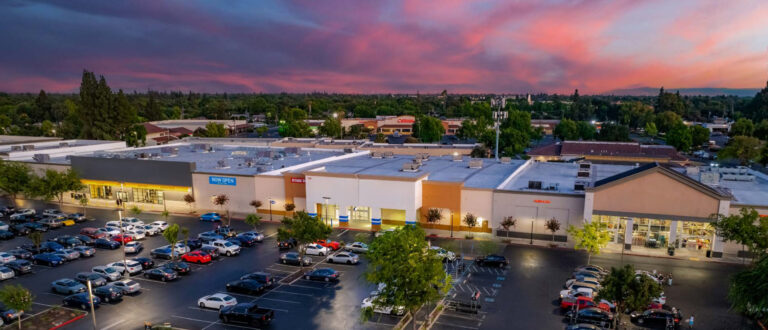
George Smith Partners successfully closed $19,100,000 in acquisition financing for a grocery-anchored shopping center in Stockton, CA. The transaction involved a fully occupied neighborhood retail center with strong anchor tenancy. The deal required a short closing timeline to finalize a 1031 exchange and included multiple TIC entities exchanging into the acquisition. GSP identified a lender that has full control of a securitization process and understood retail underwriting, focusing on the property’s 100% occupancy, strong grocery anchor, and location fundamentals. The financing provided the client with attractive leverage for the acquisition and included full-term interest-only to maximize cash flow during the initial hold period.
Advisors
Matthew Fisher
Senior Director
Grant Pugatch
Vice President
Martha Martinez
Assistant Vice President – Capital Markets & Loan Servicing
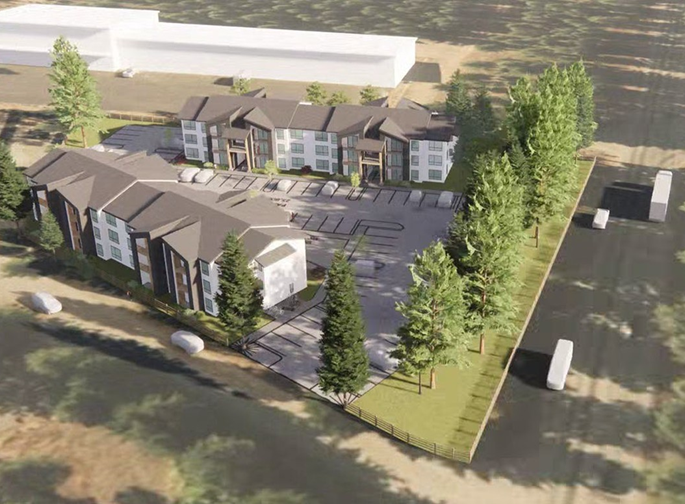
Loan Term: 5 Year Term (Construction to Perm) LTC: 70% Interest Rate: 6.75% Prepayment Terms: No prepayment penalty
George Smith Partners successfully arranged $9,750,000 in construction financing for the ground-up development of a workforce housing community in Cle Elum, Washington, a supply-constrained mountain town adjacent to the Suncadia Resort.
The loan is structured as a five-year construction-to-permanent facility with no prepayment penalty, offering flexibility through stabilization and permanent execution.
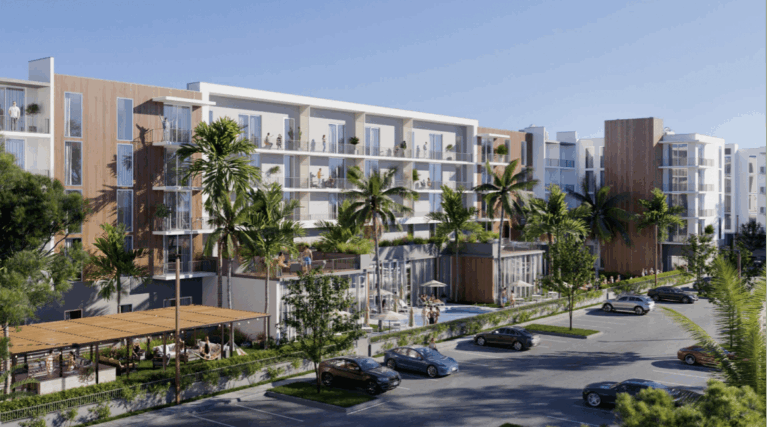
George Smith Partners successfully arranged $5,500,000 in refinance proceeds for a vacant development site in Lauderhill, Florida. The cash neutral financing enabled the Developer to reduce their cost of capital and replenish interest reserves while positioning the site to break ground over the next 12-18 months. GSP structured a fixed-rate solution with flexible prepayment terms to accommodate the developer’s timeline.
Today’s jobs report is the first “on-schedule,” complete release since September (due to the shutdown). The data was mixed, as the economy added just 50,000 jobs (vs. 75,000 expected) in December. This closed the book on 2025 as the worst year for job creation since 2009 (except for the 2020 Covid disruption). Just 584,000 jobs were created in 2025, compared to 4 million in 2022 and 2 million in both 2023 and 2024. Slowdown factors include AI disruption, mid-year tariff concerns, and government layoffs. Overall, employers are not engaging in mass layoffs. The unemployment rate fell to 4.4% (vs. 4.5% expected); however, the decline was partially due to technical revisions, leaving the employment picture still “muddy.”
The 10-year Treasury is at 4.17%, after briefly breaching the key technical level of 4.20% before immediately dropping. What about the Fed? Today’s data dropped futures market odds for a January rate cut from about 15% to 5%. The futures market now indicates no rate cut until June, with three consecutive “pause” meetings. Fedspeak: Fed Gov Kashkari stated, “My guess is we’re pretty close to neutral right now…We just need to get more data to see which is the bigger force. Is it inflation or is it the labor market?” Being in the neutral-rate range would indicate that the bar for future cuts could be rising among a more “centrist” group of policymakers.
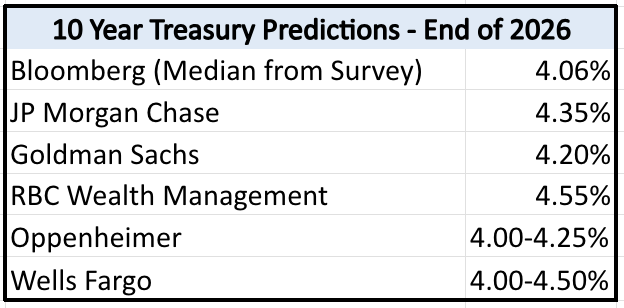
Reading the various comments from the investment banks, most analysts expect further interest rate cuts by the Fed. However, persistent inflation and continued high government debt issuance are expected to keep long-term yields from falling dramatically (“term premium”). Stay tuned…
The City of Brotherly Love is known for much more than its cheesesteaks, the Eagles, and “Its Always Sunny in Philadelphia”.
Philadelphia, which is one of America’s top 10 metros, has a robust commercial real estate market due to a variety of factors that keeps the city positioned to support long term growth.
As capital markets recalibrate after rate cuts, and investors look for cities with durable fundamentals, executional depth, and long-term demand drivers, Philadelphia stands out.
In a more disciplined investment environment, cities with strong executional track records, diverse demand drivers, and active development pipelines are pulling ahead. Rather than relying on momentum or speculation, Philadelphia’s commercial real estate market is supported by history, institutional grade product, and a structure that enables deals to transact. As we head into America’s 250th birthday, this founding American city is one to watch.
At George Smith Partners, we are extremely bullish on the city’s CRE outlook and are ready to support owners, developers, and institutions who want to expand their local portfolio or enter for the first time.
Eds, Meds, and Beds: The CRE Trifecta
The ultimate insulator in any CRE market includes three core elements: educational institutions, medical facilities, and places where people live or vacation. In the industry, we refer to this as “Eds, Meds, and Beds”, and Philadelphia has all three. The education and medical sectors are key drivers of local economies, which typically provide jobs that are sheltered from periods of economic downturns. This proliferation within the city of Philadelphia, which is known for world class institutions of higher learning, cutting edge hospitals and medical facilities, and housing, highlights real estate that will always be buoyed by demand. College enrollment is countercyclical, which means that when the broader economy slows, enrollment goes up.
These “anchor institutions”, as the former President of the Federal Reserve Bank of Philadelphia Patrick Harker put it in 2022, are:
Labor intensive
Protect against downturns
Are major boosters to local economies
Many of these anchor institutions foster high-tech growth and investment, and spill over to other sectors outside of real estate. As a historic American city, attractions, conventions, and other events draw tourists in and support the local hospitality industry.
Conversion Plays and New Developments
GSP shared a recent video on the conversion environment we see in Philly, which is unique compared to other cities. Conversions in Philadelphia have been widespread since the 1950s, when old mills and factories were first converted to residences. Over time, the city’s long-standing tax abatement program, combined with a commitment to preserving historic architecture, has fostered a conversion-friendly environment. This has resulted in millions of square feet of obsolete office, hospitality, and industrial space being repositioned into residential and mixed-use assets.
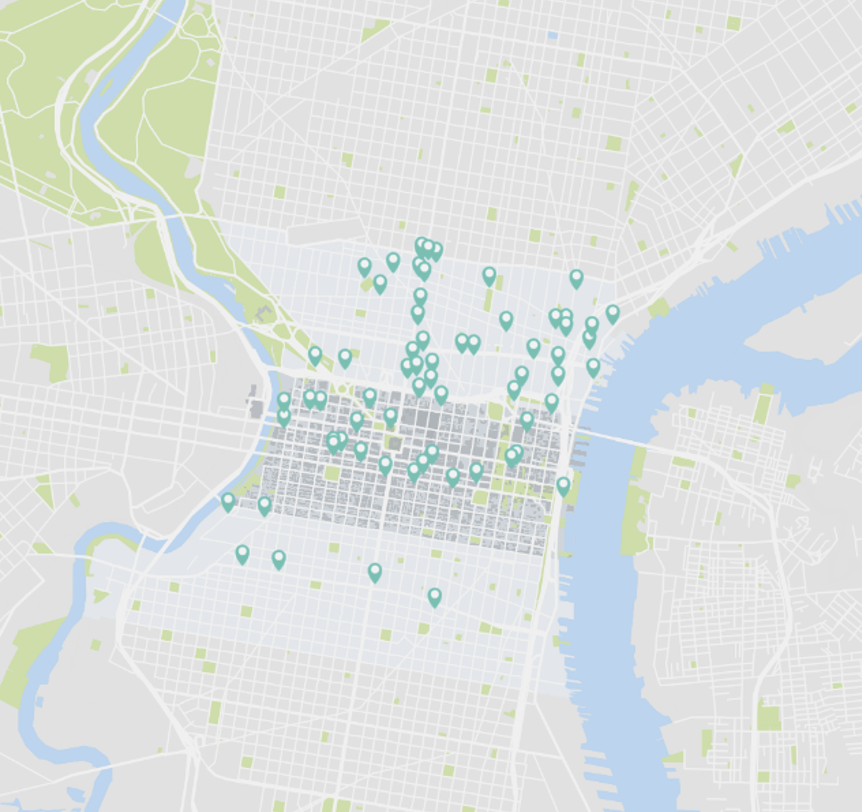
Beyond conversions, what makes Philadelphia particularly compelling in today’s market is that this momentum is not limited to legacy assets. We are witnessing meaningful uptick in new development projects in the greater Philadelphia MSA. The attached map shows development projects completed, under construction, or proposed as of December 2024.
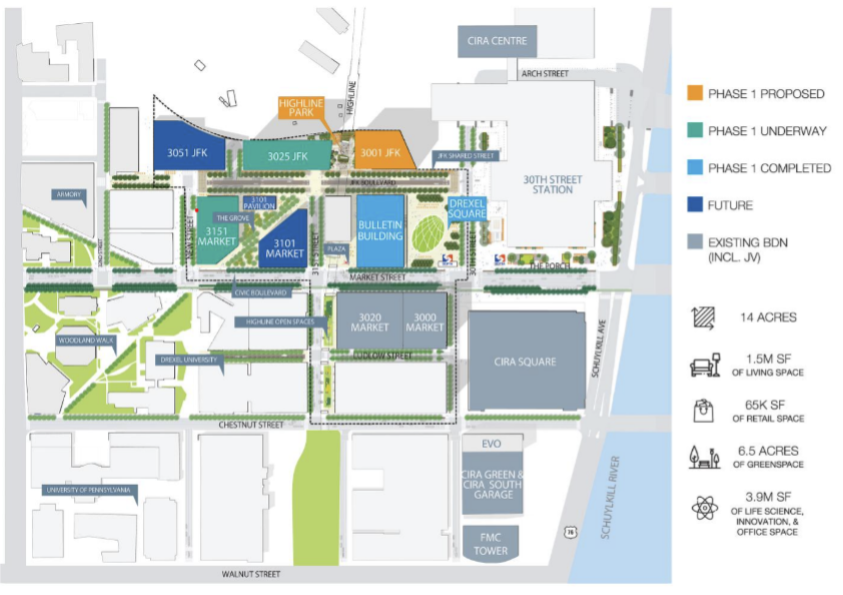
A fantastic project to highlight is Schuylkill Yards (shown below), which is one of the many noteworthy developments in the city. The focus on mixed-use and transit-oriented development is a key differentiator between Philadelphia and other major cities. This particular initiative will add 1.5M SF of living space, and over 6 acres of green space to an emerging area of central Philadelphia right across the water from 30th Street’s Amtrak and SEPTA station.
Dozens of projects beyond this one, spanning residential, commercial, healthcare, education, and more have gone online or are in the works- which is a testament to the ability of developers in the city to secure financing, and partner with the city.
Capital Markets and Why it Matters
From a capital markets perspective, Philadelphia’s eds, meds, and beds ecosystem underpins both stability and consistent rent growth across multiple asset classes. Large university systems, healthcare networks, and a growing residential base support stable occupancy today while creating long-term pricing power as new supply is absorbed. This dynamic is particularly relevant in Philadelphia, where rent growth has lagged relative to peer coastal markets and is only now entering a more normalized expansion phase.
This context materially shapes financing outcomes. Adaptive reuse projects often require bespoke capital stacks, which combine tax incentives, construction financing, and structured equity. On the other hand, ground-up multi developments benefit from relative affordability and the ability to underwrite rent growth that remains ahead of the market’s current pricing. As capital becomes more selective, Philadelphia stands out as one of the few major metros where investors can still underwrite both current yield and embedded rent growth, supported by institutional demand drivers rather than speculative assumptions.
For developers and operators active in the market, aligning capital strategy with these demand fundamentals and rent growth dynamics is critical to execution. I’m always happy to connect with groups evaluating conversions, new development, or recapitalizations to discuss how thoughtful structuring and timing can unlock long-term value in Philadelphia.